
A CIO who has spent three years and a seven-figure budget modernising IT service management will usually describe the operation as mature and the surface evidence supports the claim: incident volumes have dropped, the service desk runs on a recognised platform and monthly reports reach the board on schedule. None of that reveals where the operation actually sits on a maturity curve and most enterprises overestimate their position by a wide margin.
Reactive IT is a structural problem in the operating model, consistent across platforms, budget sizes, and industries. Organisations that operate predictably have designed predictability into their model from the outset. Mapping the distance between the two states starts with a clear definition of IT Operations Maturity.
An organisation delivers IT outcomes through three disciplines working in unison: service management, operations management and asset management. Rogue Asia defines IT Operations Maturity as how consistently those outcomes arrive and because the disciplines feed one another in daily operation, a credible assessment examines all three at once.
Each gain depends on a neighbouring discipline, which is why an organisation that scores each one in isolation measures siloed competence and reads it as operational maturity. An organisation climbs the stages as its three disciplines converge into a single operating picture.
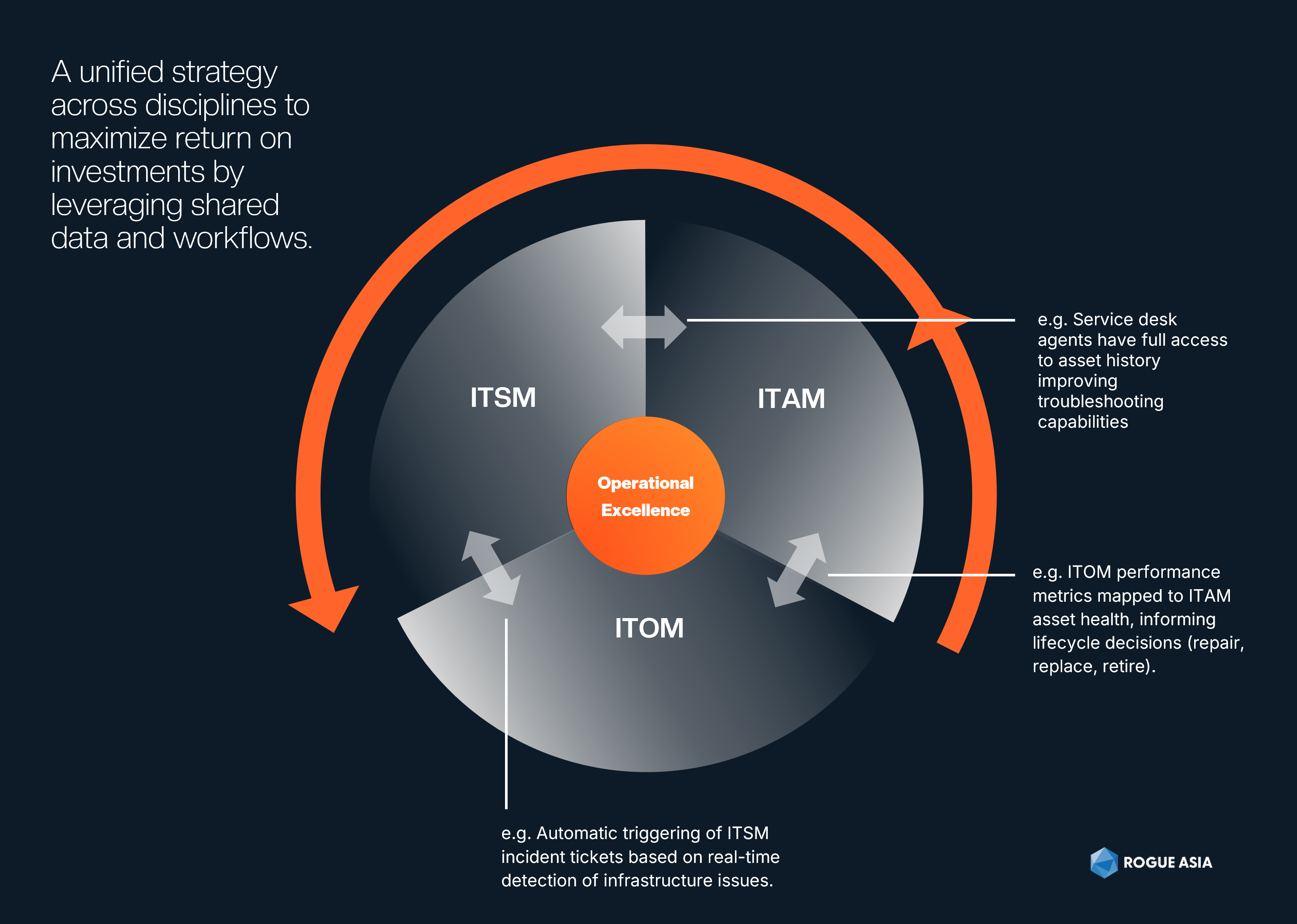
An analysis of unified IT strategies documents consistent gains across organisations that complete this convergence: faster incident resolution through contextual data, reduced risk through connected asset records, and cost optimisation through shared visibility into resource utilisation. Further research on enterprise IT management deployments quantifies the service delivery impact: organisations running natively unified ITSM and ITOM architectures resolve incidents approximately 67% faster than those on disconnected platforms.
The enterprises that treat that convergence as the objective advance faster than those that deepen one discipline in isolation, because the unification of ITSM, ITOM and ITAM is what turns three competent functions into one predictable operation.
Mature IT operations follow a consistent progression across four stages, each representing a qualitative shift in how consistently the organisation delivers outcomes: Foundation, Standardized, Integrated, and Intelligent. Rogue Asia's assessment practice uses this progression as the diagnostic lens.
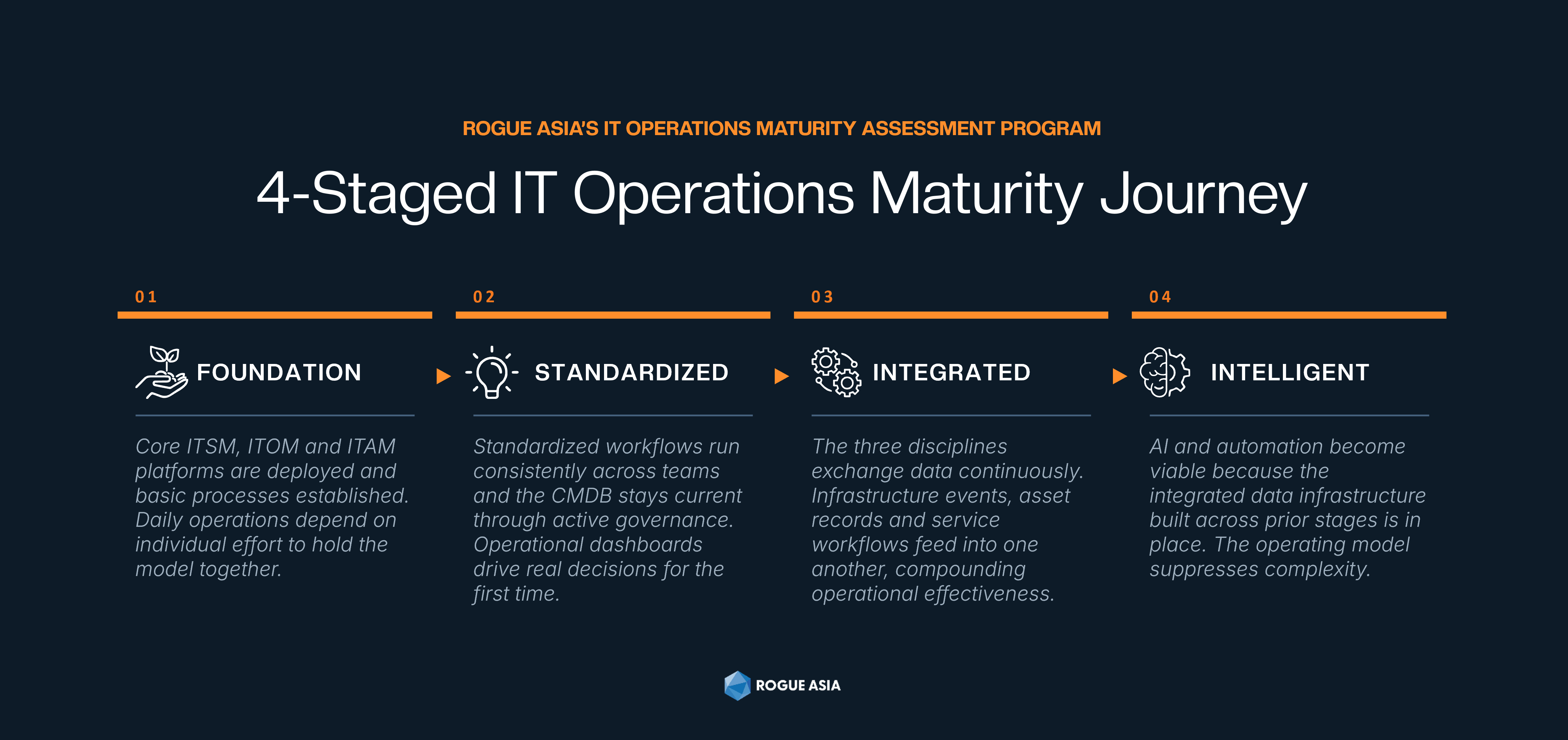
To qualify for the Foundation stage, organisations are expected to have installed the core platforms and running basic ITIL-aligned processes. SLAs and KPIs may exist on paper and asset discovery is established.
Organisations reach Standardized when the operating model catches up with the tooling. Workflows run consistently across teams, the service catalog handles routine demand, the CMDB and asset lifecycle records are actively governed, and operational dashboards begin driving real decisions.
At the Integrated stage, the three disciplines exchange information continuously. An infrastructure event now opens a service ticket without anyone touching it, resolution teams work asset health data inside the same screen and analytics draw on service, operations and asset sources at once.
AI and automation become genuinely viable at the Intelligent stage because the preceding stages have built the data infrastructure they require. Clean, integrated data flowing in real time across ITSM, ITOM, and ITAM is the substrate AI needs to produce reliable outputs.
Without an objective diagnostic, organisations default to judging themselves by where they have spent the most. A company that poured budget into an ITSM platform anchors its self-image on that platform and overlooks neglected asset governance and/or infrastructure monitoring. The weakest discipline sets the ceiling on overall maturity and self-assessment is the method least likely to expose it.
An organisation at Foundation that funds integration before standardising its workflows is connecting inconsistent processes to one another. The CMDB cannot serve as a reliable data source until governance is in place, and automation built on ungoverned inputs inherits every gap it was designed to close. Bypassing Standardized means arriving at Integrated with Foundation-level inconsistency built into every connection.
Most CIOs name AI-enabled operations as a near-term objective while their organisations have not yet reached Integrated. Models running on fragmented or stale inputs return little of operational value, which is why Intelligent is paradoxically the stage most leaders want to reach first and the one with the longest dependency chain.
No two organisations climb the maturity stages in the same order. A bank carrying regulatory risk addresses its gaps in a different sequence from a retailer protecting uptime through a peak sales season and the right starting point tracks to where the gaps hurt most, where risk concentrates and where a given investment moves the operation furthest.
A structured assessment across all three disciplines fixes that starting point. The organisations that commission one before their next technology investment enter the procurement process knowing precisely which capability gaps they are solving for. The ones that skip it tend to fund the wrong stage of the journey and extend the maturity gap by another budget cycle.
Rogue Asia's IT Ops Maturity Assessment Program is a fixed-fee diagnostic that establishes an enterprise's maturity baseline across ITSM, ITOM and ITAM, identifies the gaps holding overall capability down and delivers a prioritised improvement roadmap. Organisations that want to understand where they actually stand before committing to the next investment can begin with an initial discovery call. Book a discovery call today
Rogue Asia is a consulting-led technology services company operating across Malaysia and Singapore. We work with enterprise IT teams on operational diagnostics, platform implementation, and IT service transformation, starting with an honest picture of where you are before recommending where to go. Follow RogueAsia on LinkedIn for more insights on IT operations, service management, and enterprise technology.